


Skip to content

AI strategy · Adoption · Return

AI strategy, roadmap and adoption - costed before you commit.

We help organisations choose the AI worth doing, prove it with a working prototype, and get their teams actually using it. Every recommendation carries the economics behind it.

Why AI programmes stall

The technology is almost never the reason.

Most stalled AI programmes share a post-mortem: a pilot that worked, a business case nobody could defend, and teams who were never brought along. The model was fine. The roadmap, the ownership and the change plan were missing.

We start from the other end - the use cases that pay for themselves, sequenced into a roadmap someone owns, with the training and change work that makes them stick.

Before enthusiasm

Every recommendation comes with a number.

We model the economics before anyone commits budget. If the number does not work, we say so - a cheaper outcome than discovering it in year two.

Cost to run
At your volumes, in production, including the runs that fail.
Return
Hours released, errors avoided, revenue enabled - measured against a baseline we agree first.
Payback
When the initiative stops costing money and starts returning it.
What must be true
The assumptions the case rests on, so you know which one to watch.
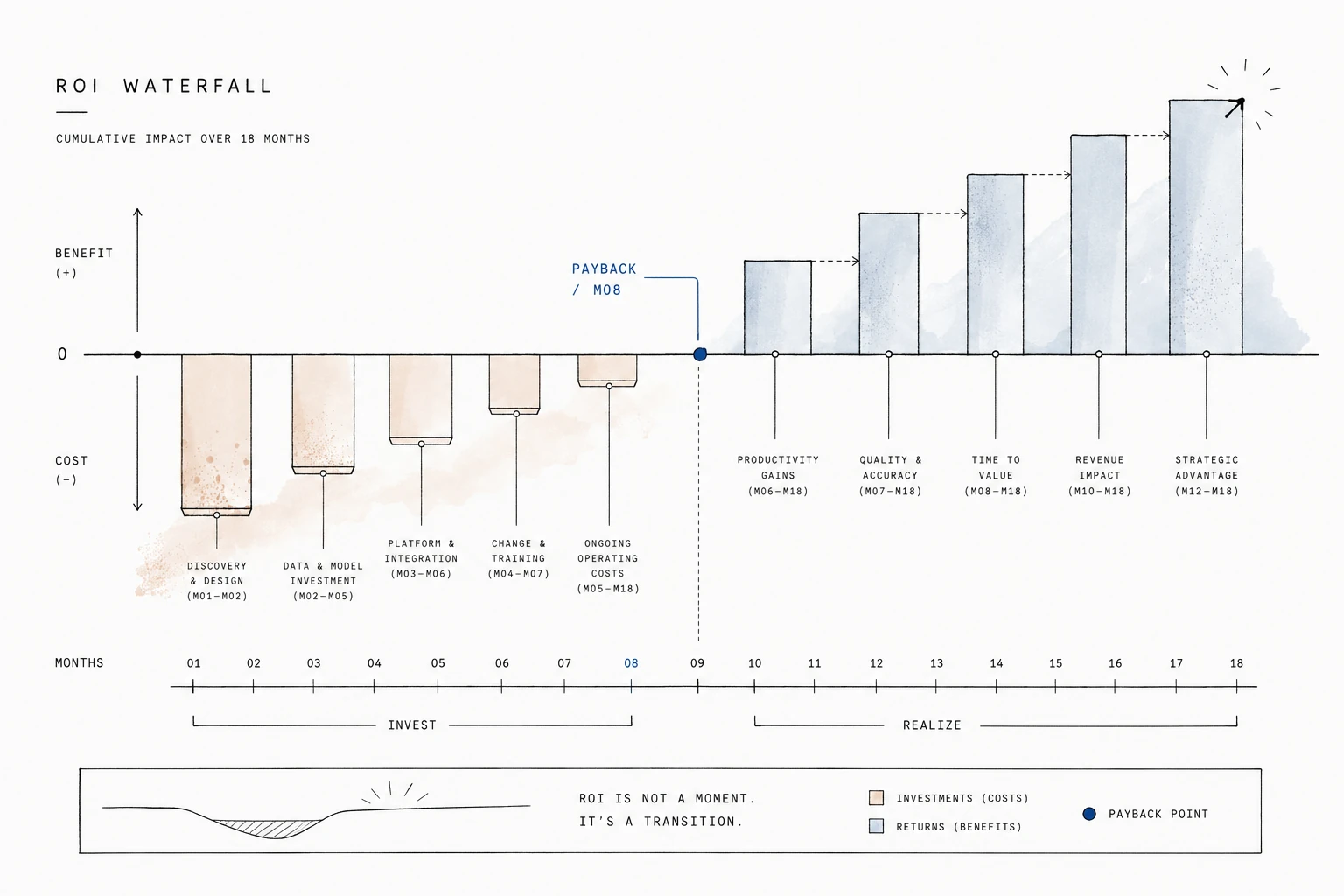
A waterfall chart over eighteen months. Five investment bars fall below the zero line - discovery and design, data and model investment, platform and integration, change and training, and ongoing operating costs. A payback point is marked at month eight, after which five benefit bars rise above the line: productivity gains, quality and accuracy, time to value, revenue impact and strategic advantage.
A programme does not pay back at launch. Investment front-loads across discovery, data, integration and change; return accumulates afterwards. The number that matters is where the two cross. (open full size)

Where to start

Fixed scope, fixed price

Six ways in, each with a defined deliverable and an end date. Larger engagements usually begin as one of these.

2–3 weeks

AI Readiness & Opportunity Assessment

A scored view of where you actually stand across data, technology, people and governance - and the shortest path to the first result worth having.

2 weeks

AI Business Case & ROI Model

What the initiative costs to run at your volumes, what it returns, when it pays back, and what would have to be true for that to hold.

Monthly

Fractional CAIO

A Chief AI Officer on retainer. Architecture decisions, vendor selection, hiring input and roadmap ownership, without the executive hire.

4–8 weeks

AI Enablement Programme

Role-based training for executives, managers, engineers and analysts, plus the champions and policy needed to make it hold after we leave.

4 weeks

PoC Sprint

A working prototype against your real data, an evaluation report, and an honest recommendation on whether to continue.

3–5 days

Call Fit Check

A direct verdict on one specific call: your realistic win probability, what is missing from your position, and what entering would cost you.

An unusual advantage

Some of this can be paid for with European R&D funding.

Where the work is genuinely novel, it can be routed through Horizon Europe, the EIC or national programmes so that R&D budget carries part of the cost - and the prototype that proves the concept becomes the evidence in the proposal.

We write those proposals ourselves. It is not a referral to a partner, and it is not a bolt-on: the people who scope the architecture write the work packages.

Next step

Tell us what you are trying to decide, build, or fund.

A first conversation costs nothing and usually ends with a straight answer about whether we are the right people for it.