
Ask an organisation what its AI programme returns and you will usually get one of three answers: a vendor's case study, a percentage with no baseline behind it, or a slightly defensive account of how hard the number is to measure.
All three are symptoms of the same thing. The business case was written after the decision, to justify it, rather than before it, to make it.
Why the usual case does not survive
A typical case says something like: this will save 30% of the time spent on X. It is not wrong so much as unfalsifiable. Nobody agreed what the current time spent on X actually is, so nobody can tell afterwards whether 30% happened.
Three specific failures show up again and again.
No baseline. If the current cost of the process was never measured, any improvement claim is unverifiable in both directions. You cannot prove success, and you cannot detect failure early enough to change course.
Gross benefit, net cost. The benefit side counts hours saved. The cost side counts the licence. Missing: integration, the change programme, the people maintaining it, the runs that fail, and the ongoing cost of evaluation.
Time saved treated as money saved. Twenty minutes returned to forty people is not a salary. It becomes real money only if it is consolidated into fewer hires, reduced overtime, higher throughput at the same headcount, or work that was previously turned away. If none of those is true, the benefit is real but it is comfort, not cash - and it should be labelled that way.
The version that holds
A defensible case has four numbers and one list.
| Element | What it means |
|---|---|
| Cost to run | Full production cost at real volumes, including failures, verification and maintenance. |
| Return | The measured baseline minus the measured post-deployment figure, converted into money by a route someone will sign off on. |
| Payback period | When cumulative return crosses cumulative cost, including the build. |
| Sensitivity | What happens to payback if adoption is half of plan, or volumes are double. |
| Assumptions | The specific things that must remain true, each with an owner watching it. |
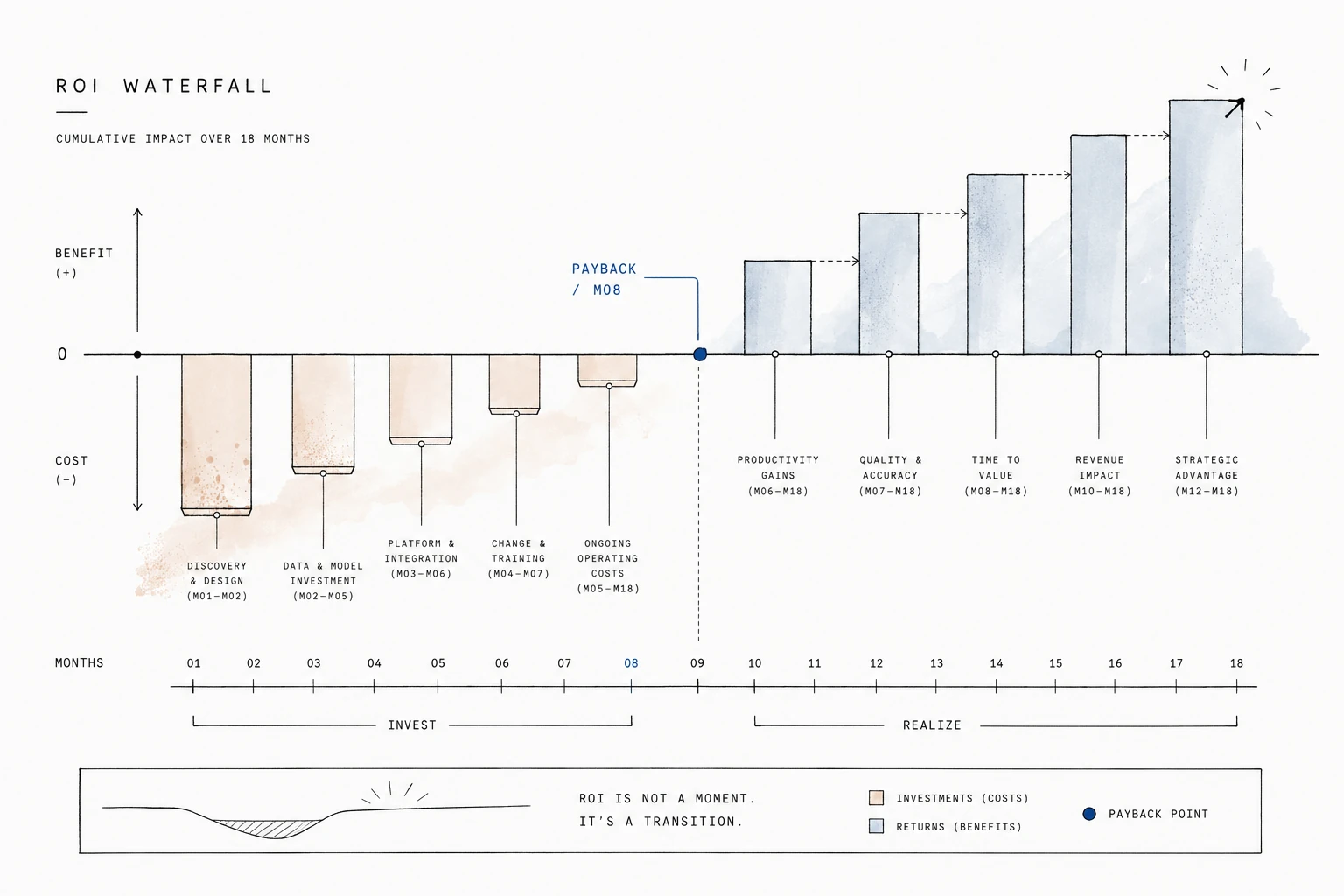
The sensitivity row is the one that changes conversations. A case that pays back in eleven months at 80% adoption and never at 30% is a different proposition from one that pays back in fourteen months almost regardless - even though the headline figure might be similar.
Converting benefit into money honestly
This is where most cases quietly cheat, so it is worth being explicit. There are only a few legitimate conversion routes:
- Cost avoided - a hire not made, a contract not renewed, overtime not worked. Strongest, because someone can point at a budget line.
- Capacity released and re-used - the same team handles more volume without growing. Legitimate, provided the extra volume actually exists.
- Revenue enabled - faster response times win business that was previously lost. Real, but needs a plausible attribution story, not a hopeful one.
- Risk reduced - fewer errors in a process where errors carry a known cost. Quantifiable when the error cost is already tracked.
If a claimed benefit maps to none of these, it is still worth having. It is just not a financial return, and calling it one is what makes the case collapse under scrutiny in year two.
Adoption is a financial assumption
The most common reason a good AI business case fails is not that the technology underperformed. It is that the projected return assumed everyone would use it, and half of them did not.
That makes adoption a line in the model, not a soft concern for the change team. If the case needs 70% of a department using the tool weekly, that number belongs in the sensitivity analysis and in the monthly review, alongside cost and accuracy. Once adoption is a tracked assumption, the change work stops being a nice-to-have and becomes the thing protecting the investment.
What to do before the next approval meeting
Take the initiative currently closest to sign-off and answer four questions in writing:
- What is the measured baseline today, and who measured it?
- What is the full running cost at production volume, including failures?
- What adoption rate does the return assume, and what happens at half that?
- Which single assumption, if wrong, breaks the case - and who is watching it?
If any of the four cannot be answered, that is not a reason to abandon the initiative. It is the work to do before committing budget to it, and it usually takes a fortnight rather than a quarter.
The organisations that get durable value out of AI are rarely the ones with the most advanced models. They are the ones that could tell you, twelve months in, exactly what they got and what it cost.